
Description
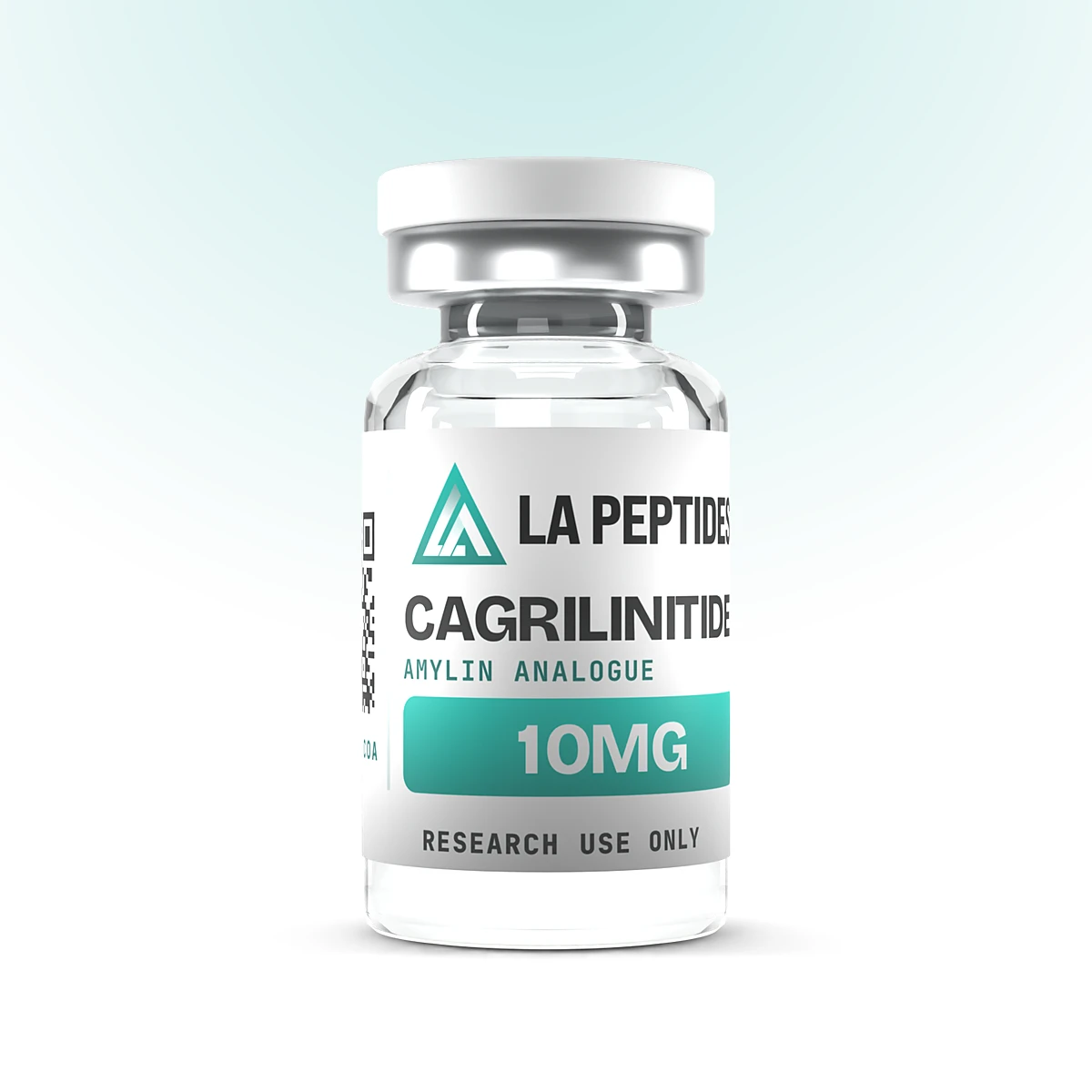
This is Cagrilintide, supplied by LA Peptides as 10mg of freeze-dried powder in a sealed vial. The compound and amount are printed clearly on the label. It’s for laboratory research only.
What is Cagrilintide?
Cagrilintide is a long-acting analogue of amylin, a hormone the pancreas releases with insulin after meals. Amylin slows stomach emptying and signals fullness to the brain.
Natural amylin clumps and breaks down quickly. Cagrilintide has sequence changes that keep it from clumping and a fatty acid chain that lets it bind albumin, so it lasts about a week in studies.
Cagrilintide vial specifications
- Compound: Cagrilintide
- Amount: 10mg per vial
- Form: lyophilized (freeze-dried) powder
- Container: sealed glass vial with flip-off cap
- SKU: LAP-CAGRI-10
- Labeling: compound and amount printed on every vial
- Use: laboratory research only, not for human or veterinary use
What the research says
Novo Nordisk developed it, and it’s been studied both alone and alongside GLP-1 class peptides in human trials on body weight.
This vial is research material for laboratory use only. It isn’t approved for use in people.
If you’d like to read the papers yourself, start with this PubMed search.
Working out the concentration
How much liquid you add decides the concentration. For this vial holding 10mg:
- 1ml of bacteriostatic water gives 10mg/ml
- 2ml of bacteriostatic water gives 5mg/ml
- 3ml of bacteriostatic water gives about 3.33mg/ml
Choose whichever volume makes the math simplest for your protocol, and label the vial with the concentration and the mixing date.
Storing and mixing
Unopened, the vial is happiest in a fridge at 2 to 8°C, or frozen for longer storage. Let it warm up to room temperature before you break the seal, so condensation doesn’t get in.
Most labs reconstitute it with bacteriostatic water. Add it slowly against the glass, then roll the vial between your fingers until it clears. Shaking can damage peptide chains, so skip that. Refrigerate the mixed solution and use it within about a month. A peptide case helps if vials travel between benches.
Other products to look at
Researchers who order this often look at these too:
- LAP-2 (T) 30mg, dual-receptor peptide analogue
- LAP-2 (T) 15mg, dual-receptor peptide analogue
- LAP-1 (S) 10mg, single-receptor peptide analogue
- LAP-1 (S) 5mg, single-receptor peptide analogue
You’ll find more like it in our glp-1 peptides range, or browse every vial on the research peptides page.
Before you start
Have everything ready before you break the seal: bacteriostatic water, sterile syringes, alcohol swabs, a marker or labels, and space in the fridge. Working in a clean area with gloves on keeps contamination down. If you’re mixing several compounds, do one at a time and label each vial as soon as it’s done.
Once a vial is mixed, it should be used within a few weeks. If your study runs longer than that, two smaller vials often make more sense than one large one.
Cagrilintide FAQ
How much is in the vial?
10mg of lyophilized peptide. The amount is printed on the label.
Is it clearly labeled?
Yes. The compound name and amount are printed on every vial.
What do I need to reconstitute it?
Bacteriostatic water and a sterile syringe. We sell BAC water in 10ml vials.
Can it be used on people or animals?
No. It’s sold for laboratory research only and isn’t approved for human or veterinary use.
Buy Cagrilintide online
Pick your quantity, add it to the cart and you’re done in a couple of minutes. Need more than one compound? Our peptide bundles save about 15% over buying each item on its own.
For laboratory research use only. Not for human or veterinary use. Not evaluated by the FDA.

Reviews
There are no reviews yet.