
Description
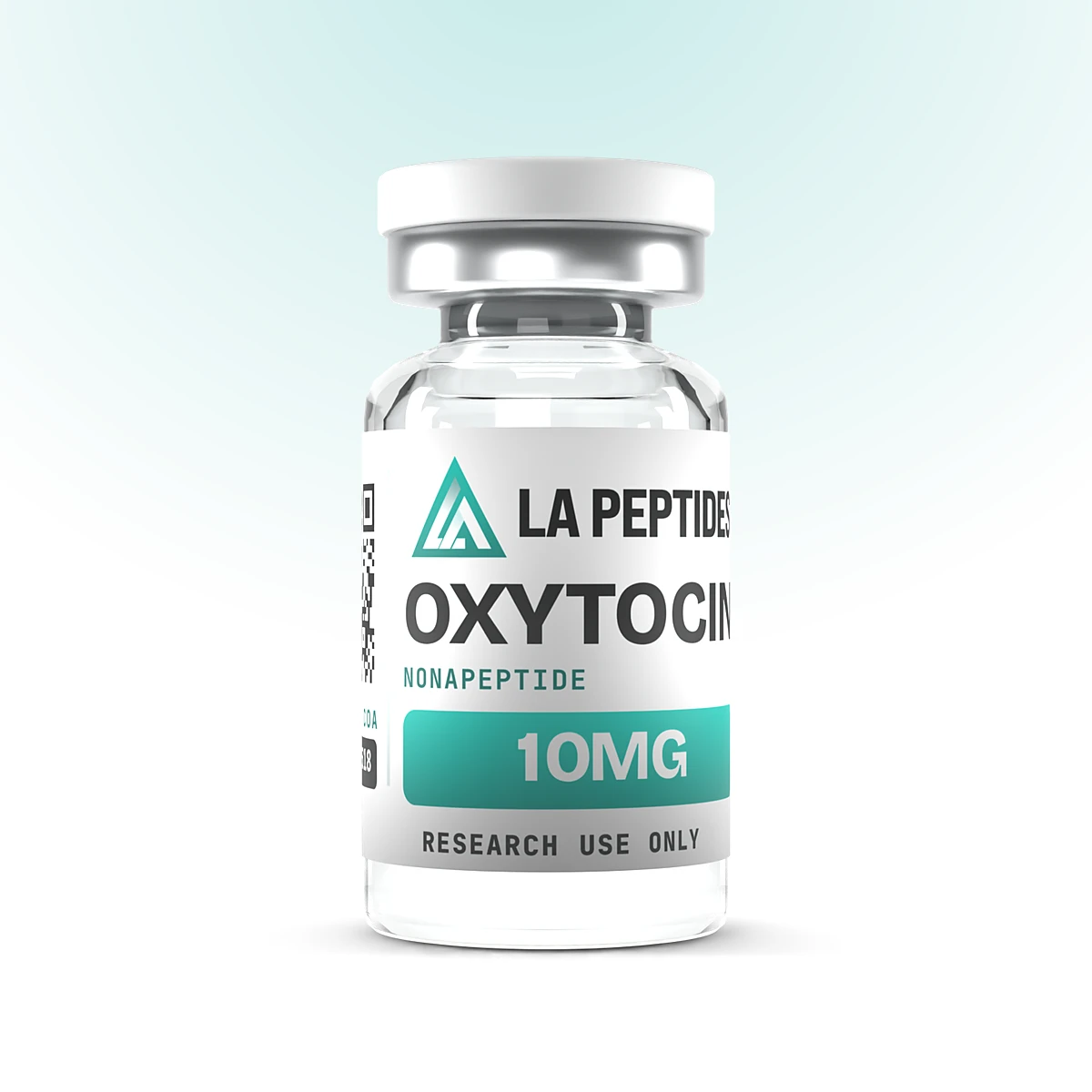
Oxytocin from LA Peptides comes as 10mg of lyophilized powder in a sealed glass vial, made for laboratory research. The compound and amount are printed clearly on the label.
What is Oxytocin?
Oxytocin is a nine-amino-acid peptide hormone (Cys-Tyr-Ile-Gln-Asn-Cys-Pro-Leu-Gly-NH2). The two cysteines are joined by a disulfide bridge that closes the first six amino acids into a ring.
The hypothalamus makes it and the pituitary releases it. It’s best known for its role in childbirth and nursing, and for its effects on social bonding.
Oxytocin vial specifications
- Compound: Oxytocin
- Amount: 10mg per vial
- Form: lyophilized (freeze-dried) powder
- Container: sealed glass vial with flip-off cap
- SKU: LAP-OXY-10
- Labeling: compound and amount printed on every vial
- Use: laboratory research only, not for human or veterinary use
Research so far
Vincent du Vigneaud worked out its structure and made it in the lab in 1953. It was the first peptide hormone ever synthesized, and the work won him the 1955 Nobel Prize in Chemistry.
A huge body of research has followed, from obstetrics to social behavior studies using nasal sprays.
If you’d like to read the papers yourself, start with this PubMed search for Oxytocin.
Working out the concentration
How much liquid you add decides the concentration. For this vial holding 10mg:
- 1ml of bacteriostatic water gives 10mg/ml
- 2ml of bacteriostatic water gives 5mg/ml
- 3ml of bacteriostatic water gives about 3.33mg/ml
Pick a volume that makes your measurements easy, then write the concentration and the date on the vial. It’s a small step that saves confusion a week later.
How to reconstitute and store it
Keep the sealed vial in the fridge, or in the freezer if you won’t get to it for a few months. Before you open it, let it come to room temperature so moisture doesn’t condense inside.
Most labs reconstitute it with bacteriostatic water. Run the liquid slowly down the inside wall of the vial and swirl gently. Don’t shake it. Once mixed, keep it refrigerated and use it within a few weeks. A peptide case helps if vials travel between benches.
Related research peptides
If you’re planning a wider study, these are worth a look:
- PT-141/Oxytocin Nasal Spray, 10mg each in a 10ml nasal spray
- PT-141 10mg, cyclic heptapeptide (melanocortin agonist)
- PT-141 Nasal Spray, 10mg in a 10ml nasal spray
- Kisspeptin-10 10mg, decapeptide (KISS1R agonist)
You’ll find more like it in our hormone peptides range, or browse every vial on the research peptides page.
Before you start
Have everything ready before you break the seal: bacteriostatic water, sterile syringes, alcohol swabs, a marker or labels, and space in the fridge. Working in a clean area with gloves on keeps contamination down. If you’re mixing several compounds, do one at a time and label each vial as soon as it’s done.
Once a vial is mixed, it should be used within a few weeks. If your study runs longer than that, two smaller vials often make more sense than one large one.
Oxytocin FAQ
How much is in each vial?
10mg of lyophilized peptide. The amount is printed on the label.
Is it clearly labeled?
Yes. The compound name and amount are printed on every vial.
What do I need to reconstitute it?
Bacteriostatic water and a sterile syringe. We sell BAC water in 10ml vials.
Can it be used on people or animals?
No. It’s sold for laboratory research only and isn’t approved for human or veterinary use.
Order Oxytocin today
Add it to your cart and check out in a couple of minutes. It’s also part of the Mulholland Bundle, which saves about 15% over buying each item on its own.
For laboratory research use only. Not for human or veterinary use. Not evaluated by the FDA.


Reviews
There are no reviews yet.