
Description
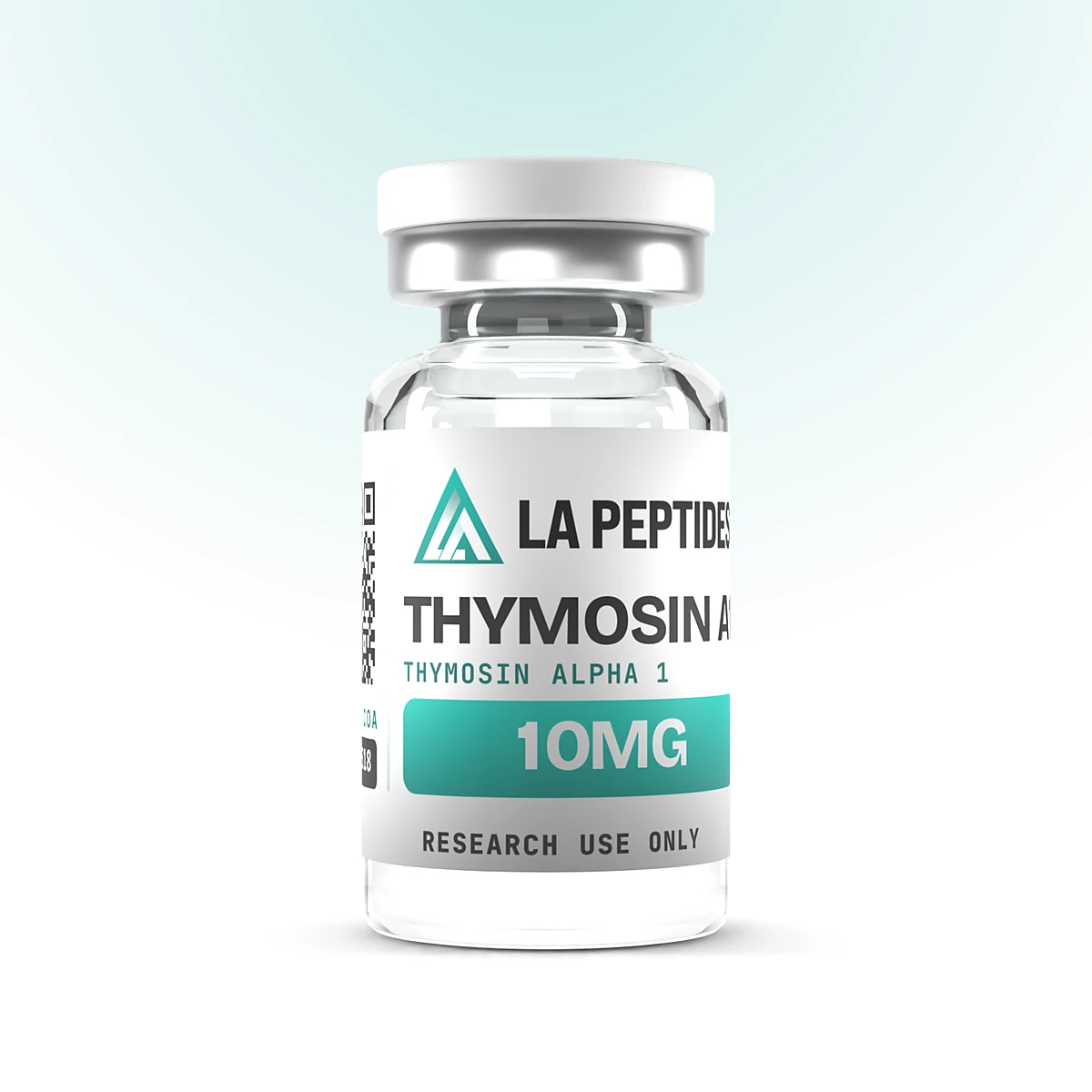
This is Thymosin Alpha 1, supplied by LA Peptides as 10mg of freeze-dried powder in a sealed vial. Every batch has its own certificate of analysis, and you can pull it up by scanning the QR code on the side of the label. It’s for laboratory research only.
What is Thymosin Alpha 1?
Thymosin Alpha 1 is a 28-amino-acid peptide with an acetyl group on its first residue. It’s cut from a larger protein called prothymosin alpha, and it was first isolated from thymus tissue.
Its main research interest is the immune system, especially T cells and dendritic cells. It’s been studied as an immune modulator for decades.
Thymosin Alpha 1 vial specifications
- Compound: Thymosin Alpha 1
- Amount: 10mg per vial
- Form: lyophilized (freeze-dried) powder
- Container: sealed glass vial with flip-off cap
- SKU: LAP-TA1-10
- Testing: batch certificate of analysis, linked by QR code on the label
- Use: laboratory research only, not for human or veterinary use
What the research says
Allan Goldstein’s group isolated it in 1977 from a thymus extract called thymosin fraction 5. A synthetic version, thymalfasin, is sold under the name Zadaxin in more than 30 countries, mostly for hepatitis B and C, but it isn’t approved by the FDA.
That gives Thymosin Alpha 1 a larger body of human data than most research peptides. Our vial is for laboratory research only.
If you’d like to read the papers yourself, start with this PubMed search for Thymosin Alpha 1.
Checking the batch COA
Every batch gets its own certificate of analysis, and the QR code on the label takes you straight to it. Look for the lot number, the test date and the purity figure. If the lot on the paperwork doesn’t match the lot on the vial, set the vial aside until it’s sorted out.
File the COA with the rest of your study notes. If results ever shift between batches, it’s the first thing you’ll want to check.
Working out the concentration
How much liquid you add decides the concentration. For this vial holding 10mg:
- 1ml of bacteriostatic water gives 10mg/ml
- 2ml of bacteriostatic water gives 5mg/ml
- 3ml of bacteriostatic water gives about 3.33mg/ml
Choose whichever volume makes the math simplest for your protocol, and label the vial with the concentration and the mixing date.
Storing and mixing
Unopened, the vial is happiest in a fridge at 2 to 8°C, or frozen for longer storage. Let it warm up to room temperature before you break the seal, so condensation doesn’t get in.
Most labs reconstitute it with bacteriostatic water. Add it slowly against the glass, then roll the vial between your fingers until it clears. Shaking can damage peptide chains, so skip that. Refrigerate the mixed solution and use it within about a month. A peptide case helps if vials travel between benches.
Other products to look at
Researchers who order this often look at these too:
- BPC-157/TB500 Nasal Spray, 10mg each in a 10ml nasal spray
- BPC-157 Capsules, 500mcg per capsule, 60 capsules
- TB-500 Capsules, 500mcg per capsule, 60 capsules
- Wolverine Capsules, 500mcg + 500mcg per capsule, 60 capsules
You’ll find more like it in our recovery peptides range, or browse every vial on the research peptides page.
Thymosin Alpha 1 FAQ
How much is in the vial?
10mg of lyophilized peptide. The amount is printed on the label.
Is every batch tested?
Yes. Each batch has a certificate of analysis, and the QR code on the vial opens the one for your batch.
What do I need to reconstitute it?
Bacteriostatic water and a sterile syringe. We sell BAC water in 10ml vials.
Can it be used on people or animals?
No. It’s sold for laboratory research only and isn’t approved for human or veterinary use.
Buy Thymosin Alpha 1 online
Pick your quantity, add it to the cart and you’re done in a couple of minutes. Need more than one compound? Our peptide bundles save about 15% over buying each item on its own.
For laboratory research use only. Not for human or veterinary use. Not evaluated by the FDA.


Reviews
There are no reviews yet.